Why New Commercial and Residential Projects in Pickaway, Fairfield, and Franklin Counties Are Choosing Electric-Only Service
— Trends, Impacts, and What Civil Engineers Should Do
Across Central Ohio — including Pickaway, Fairfield, and Franklin counties — owners and design teams are increasingly specifying electric-only service for new commercial and residential construction. This shift is driven by local policy and incentives, improving electric technologies (heat pumps, induction cooking), tenant and investor demand for lower operational emissions, and owner preference to avoid future stranded gas infrastructure. For civil engineers handling site utilities, grading, permitting, and constructability, electrification changes early design priorities and creates new coordination, space, and scheduling considerations.
Regional context
Local incentives and codes: State- and utility-level rebate programs and municipal policies across the Columbus metro area increasingly support heat pumps, electric water heating, and EV infrastructure. Jurisdictions in these three counties are actively reviewing electrification measures as part of permitting and sustainability initiatives.
Grid planning and capacity: Electric load growth — particularly EV charging — is a planning focus for regional utilities. Transformer lead times and feeder capacity/upgrade schedules can materially affect project timelines in this region.
Key site- and civil-design impacts
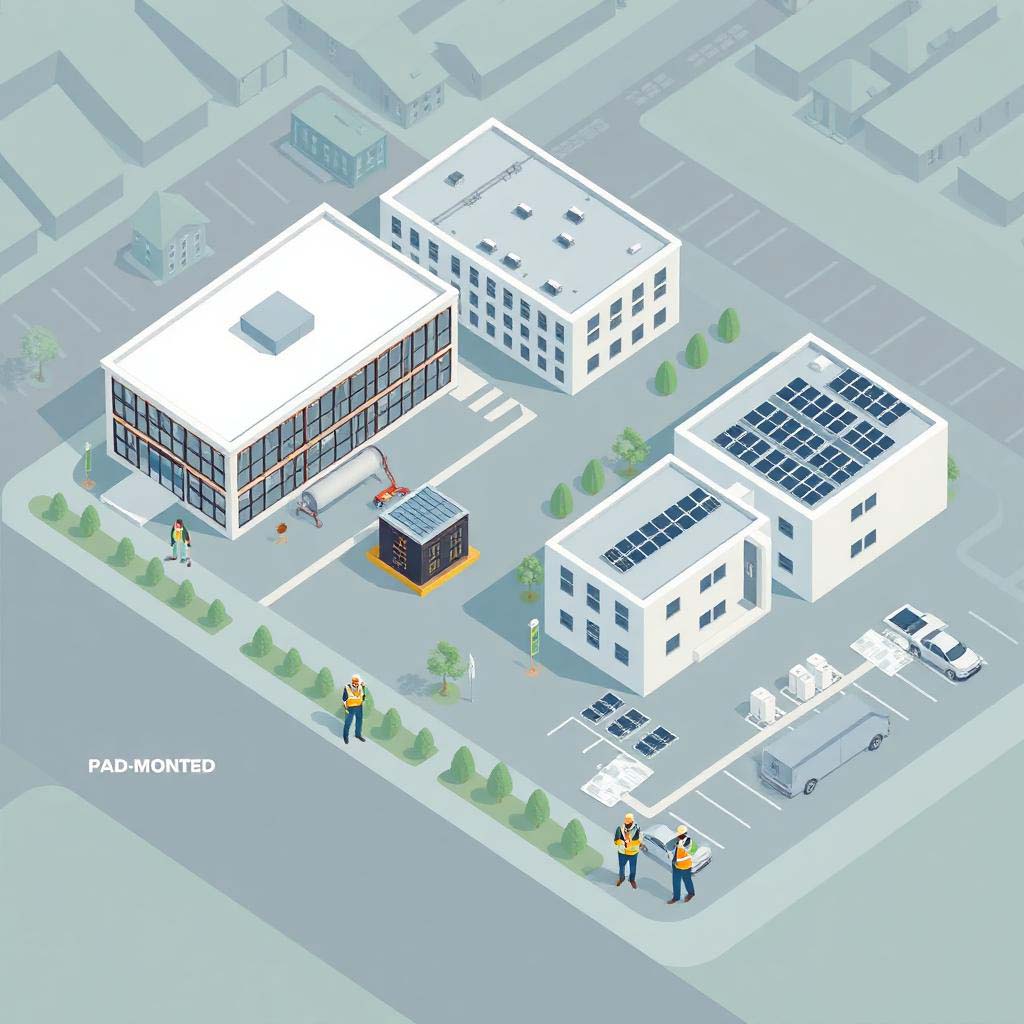
Increased electrical capacity and footprint: All-electric buildings commonly require larger service risers, bigger pad-mounted transformers, expanded electrical rooms or vaults, and more extensive underground ductbank infrastructure. Civil plans must reserve adequate pad space and clearances.
Utility coordination becomes critical path: With gas service removed or minimized, electric utility availability and upgrade schedules more frequently determine contract milestones. Early utility engagement and written capacity confirmations reduce schedule risk.
Trenching, routing, and easements: Conduit sizes, separation clearances, and vault access differ from gas mains. Trench layouts, restoration strategies, and easement exhibits must reflect electric-only routing to avoid onsite conflicts.
Space for energy storage and generation: BESS, PV inverters, and on-site generation need pads, access, secondary containment, and potential stormwater/permitting review — plan these in the site program.
EV charging backbone: Anticipate high parking-area electrical demand; provide scalable raceways, spare conduits, and centralized distribution locations to avoid costly retrofits.
Fire, safety, and AHJ coordination: Removing gas reduces some combustible-fuel risks, but BESS, switchgear, and chargers introduce new fire-safety, ventilation, and access requirements that require early AHJ and fire marshal engagement.
Cost and sequencing: Upfront civil and electrical scopes often increase; however, incentives and lifecycle savings can offset higher initial costs. Transformer procurement, utility interconnection studies, and site electrical construction can be schedule drivers.
Practical recommendations — Harral and Stevenson approach
- Engage the electric utility in schematic design: Obtain available-capacity or reservation letters and clarify typical transformer lead times and interconnection process for the specific service territory.
- Perform early electrical load modeling: Include heat pumps, electric water heating, cooking loads, EV charging scenarios, and any BESS or on-site generation in preliminary loads to size feeders, conduits, transformer pads, and metering.
- Reserve capacity and routing: Provide oversized sleeves, spare conduits, and transformer pads sized for future growth so upgrades require minimal civil rework.
- Coordinate multidisciplinary teams from day one: Align MEP, structural, site/civil, landscape, and the AHJ on equipment placement, clearances, and delivery/maintenance access. Early fire marshal input is essential for BESS siting.
- Design a scalable EV backbone: Plan centralized distribution, metering, and spare conduit to allow phased charger deployment without major pavement work.
- Evaluate resilience needs: Determine whether BESS, on-site generation, or generator backup is needed and allocate space, structural support, and containment accordingly.
- Use whole-life cost and risk analysis: Compare electric-only, hybrid, and gas options including demand charges, incentives, maintenance, carbon-risk exposure, and potential utility upgrade costs.
- Mitigate schedule risk: Consider owner procurement of long-lead items (transformers, switchgear) and include contingency for utility upgrade timing in project schedules and budgets.
Project-type notes
- Multifamily: Centralized electrical rooms, tenant metering strategies, and parking-charger backbones are priorities.
- Low-rise commercial/retail: Coordinate tenant-fit loads (kitchens, make-up air) and service-entrance locations early.
- Office/mixed-use: Plan for demand management (submetering, peak-shaving) and space for BESS to reduce demand charges.
- Large commercial/industrial: Assess process-heat needs early; hybrid or fuel-specific solutions may still be required.
Conclusion / Next step
Electrification is reshaping civil engineering scope in Pickaway, Fairfield, and Franklin counties. Early utility engagement, robust load modeling, reserved site capacity for transformers/BESS/EV infrastructure, and integrated team coordination are the most effective ways to control cost and schedule risk while delivering future-ready sites.
Craig E. Stevenson PE, PS
Partner
O: 740-497-4432 ext. 101
C: 614-561-7961
cstevenson@harralstevenson.com
Article: March 9, 2026
Related services
Talk to us
Harral and Stevenson is a full-service civil engineering and professional surveying firm with offices in Circleville, Lancaster and Springfield, Ohio.